
Ares Management Corporation (ARES), headquartered in Los Angeles, California, operates as an alternative asset manager. Valued at $41.5 billion by market cap, the company invests in credit, real assets, private equity, and secondaries market.
Companies worth $10 billion or more are generally described as “large-cap stocks,” and ARES perfectly fits that description, with its market cap exceeding this mark, underscoring its size, influence, and dominance within the asset management industry. ARES leverages a broad, diversified platform across private credit, private equity, real estate, and other alternatives, with $391.5 billion in private credit AUM. Its global footprint of 35+ offices in 15+ countries adds local market knowledge and sourcing relationships, combining on-the-ground expertise with a global platform for a more informed, competitive approach.
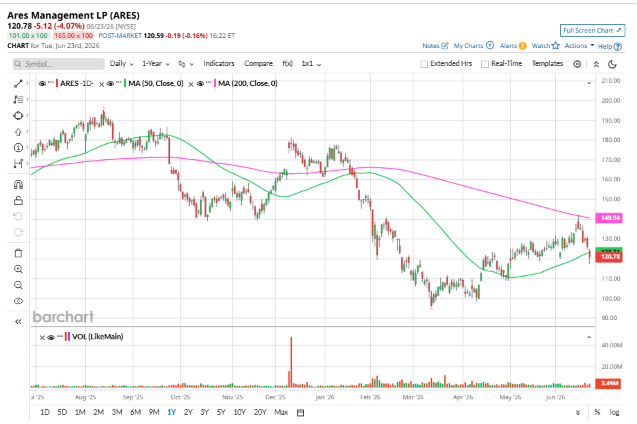
Despite its notable strength, ARES slipped 38.1% from its 52-week high of $195.26, achieved on Aug. 13, 2025. Over the past three months, ARES stock has gained 12.8%, outperforming the Dow Jones Industrials Average’s ($DOWI) 11.8% gains during the same time frame.
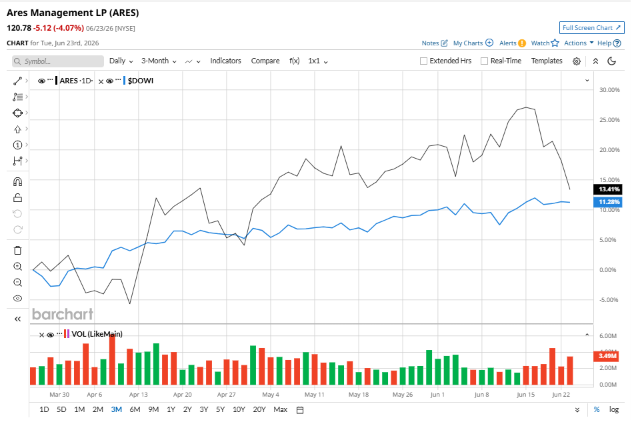
Shares of ARES fell 25.3% on a YTD basis and dipped 27% over the past 52 weeks, underperforming DOWI’s YTD gains of 7.5% and 21.3% returns over the last year.
To confirm the bearish trend, ARES has been trading below its 200-day moving average since late January. The stock is trading below its 50-day moving average recently.
On May 1, ARES shares closed up more than 1% after reporting its Q1 results. Its adjusted EPS of $1.24 missed Wall Street expectations of $1.32. The company’s revenue stood at $1.4 billion, up 28.3% year over year.
In the competitive arena of asset management, Apollo Global Management, Inc. (APO) has taken the lead over ARES, with a 9.8% downtick on a YTD basis and 2.6% losses over the past 52 weeks.
Wall Street analysts are moderately bullish on ARES’ prospects. The stock has a consensus “Moderate Buy” rating from the 19 analysts covering it, and the mean price target of $151.06 suggests a potential upside of 25.1% from current price levels.