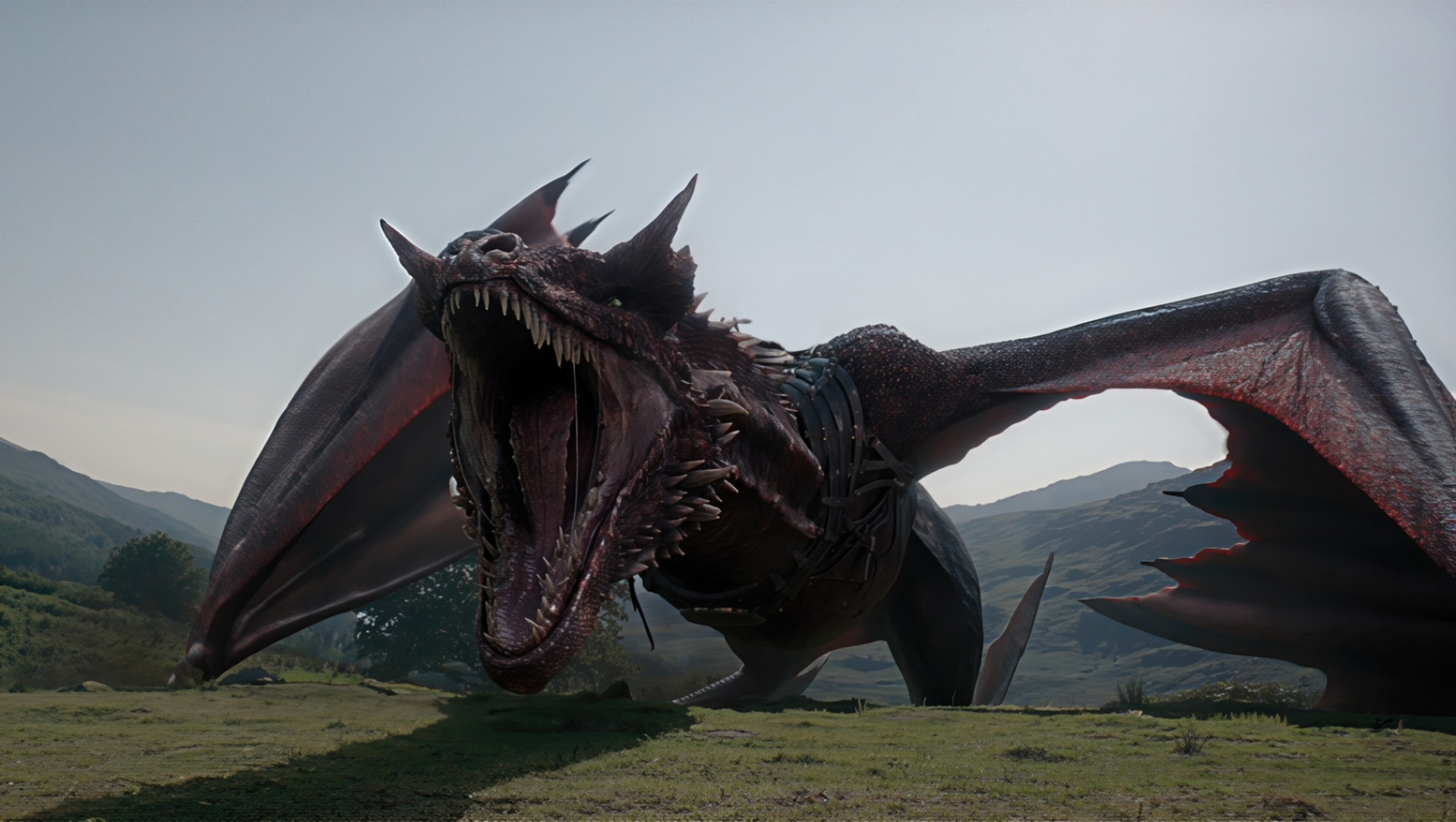
Before we do a “House of the Dragon” flyby to examine its place in high fantasy’s conquest of TV and film, let’s talk about Sheepstealer.
The “Game of Thrones” prequel boasts many dragons, most of them bound to the Targaryen royal bloodline. You could sing their names in a tune set to the intro melody of “Rudolph, the Red-Nosed Reindeer,” if you wanted: “There’s Caraxes and Syrax and Vhagar and Vermax/ Sunfyre and Dreamfyre and a dead one called Arrax . . .”
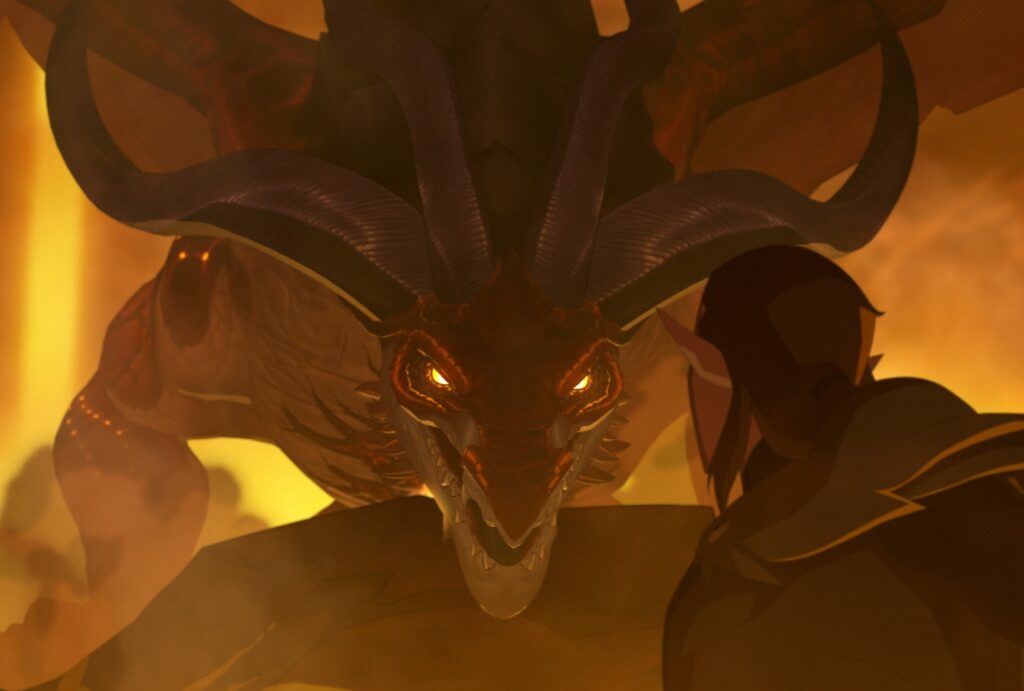
Next to them, Sheepstealer boasts no glorious lineage or handsome metallic scales. He’s just some mud-brown monstrosity roaming the Vale of Arryn and treating livestock like campfire marshmallows. As Season 3 opens, the wild dragon has yet to be officially introduced by name, although he makes his first appearance in the second season finale. That’s when Rhaena Targaryen (Phoebe Campbell), who abandoned a caravan meant to take her to safety, finds him after a long, desperate hunt — just a girl standing in front of an untamed drake, asking him to love her.
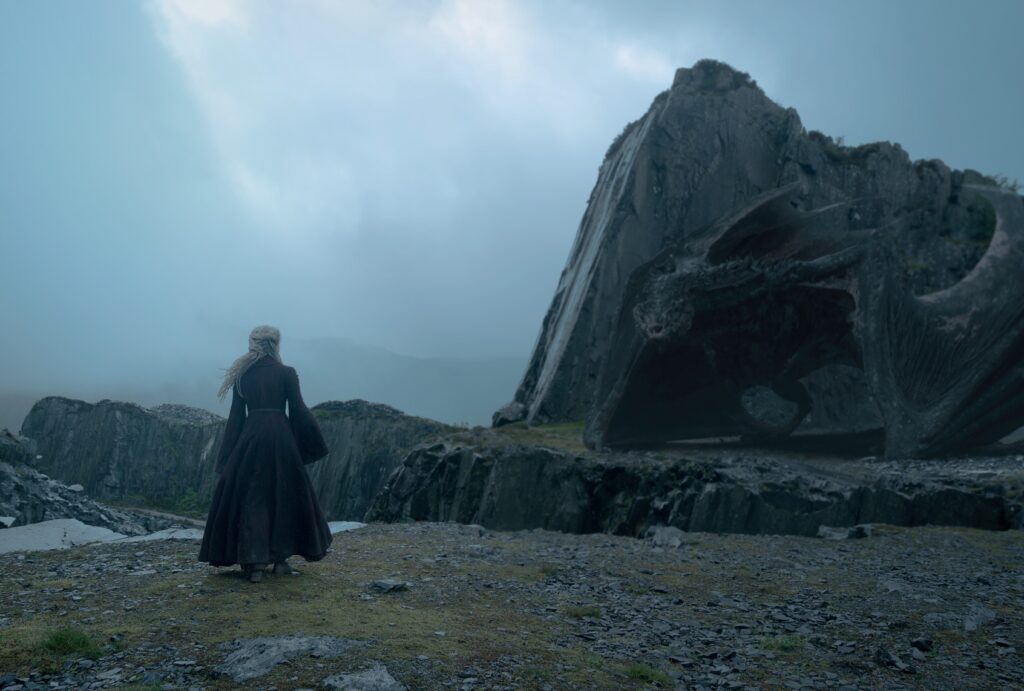
(Photograph by Theo Whiteman/HBO) Phoebe Campbell in “House of the Dragon.”
Readers of George R.R. Martin’s books may recognize that this diverges from the written version of Westeros lore. “Fire & Blood” says that Sheepstealer was claimed by a “small brown girl” called Nettles. The series assigns that role to the highborn daughter of Daemon Targaryen (Matt Smith), a young lady who wants to be a dragonrider more than anything, but has no dragon to her name. Worse, the one that might have passed down to her, her late mother’s dragon Vhagar, was stolen by her cruel cousin Aemond (Ewan Mitchell).
Lacking a dragon — and, in her mind, sufficient worth to her family — Rhaena is relegated to watching over her youngest half-brothers, Viserys and Aegon, while her sister Baela (Bethany Antonia) soars through the clouds on the back of her scaled steed Moondancer. Oof, right? If I were Rhaena, I’d run for the hills too.
What happens next may hit everyone who dreams of saddling a dragon squarely in the chest. Rhaena doesn’t wait for her luck to change. She pursues what she wants, regardless of the danger. She is that queen who’s ready to claim what’s hers or die trying.
Take another step back, though, and consider how recently dragon stories became mainstream imaginings in the first place, along with fantasy’s ascent on our screens.
The global popularity of “A Song of Ice and Fire” makes it easy to forget that not long ago, studios viewed stories like it as too niche to merit large investment.
Warner Bros. Discovery and HBO blew tremendous resources on Season 3 of “House of the Dragon” simply to make sure one significant skirmish, the Battle of the Gullet, looks as terrifying as Martin spells out on the page. More terrifying, actually; the book’s account is fairly straightforward, mentioning little about, say, sailors sliding around in their shipmates’ blood and guts.
A behind-the-scenes teaser trailer boasts of expending 25 tons of propane to create a realistic approximation of dragon fire and setting a new world record for setting stunt performers on fire in a single take. For the curious, the number to beat is 23 – but please, don’t try that at home.
If one were to step back in time through some magical gateway and read those figures to a past HBO executive, that person probably would have died of a laughing fit. That’s because for the longest time, high fantasy was associated not with spectacle but pasty, awkward kids playing Dungeons & Dragons in their mother’s basements.
Anything related to J.R.R. Tolkien and C.S. Lewis, the modern-day grandsires of popular high fantasy, came before American audiences as cartoon specials by the likes of Rankin/Bass or Ralph Bakshi, who in 1978 attempted to bring “The Lord of the Rings” to life with rotoscoped animation.
For three glorious seasons between 1983 and 1985, ‘80s kids also had the “Dungeons & Dragons” animated series with its two girl heroes: an acrobat and a thief with an invisibility cloak. No pet dragons, though — just a baby unicorn, representing the fantasy mascot ruling many of that era’s pre-teen accessory drawers.
Dragon girls are basically a modern version of the unicorn girl, or the horse girl. Their foremothers may have read The Pit Dragon Chronicles by Jane Yolen, Ursula K. Le Guin’s Earthsea Cycle books and the works of Anne McCaffrey, who gave us the Dragonriders of Pern.
Meanwhile, the unicorn faithful were served by one of Tom Cruise’s earliest action roles, 1985’s “Legend,” which cast him as a hero pledged to rescue a virginal damsel and her magical equine companion from a satanic cad played by Tim Curry. Around that same time, the biggest dragon to hit theaters, Falkor from 1984’s “The NeverEnding Story,” looked more like a whale-sized puggle than anything fierce.
This doesn’t mean we don’t love a luck dragon. We absolutely do! Know that “Stranger Things” warmed my cold stone heart when Dustin sang a rendition of “The NeverEnding Story” theme while his friends were being chased by a gigantic Mind Flayer.
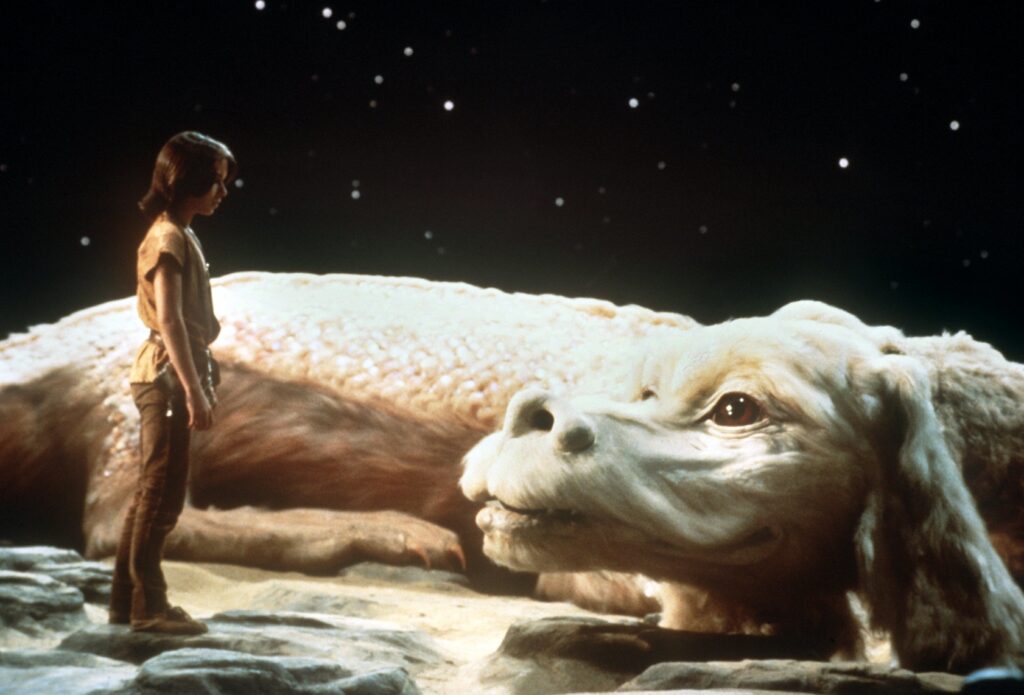
(Photo by dpa/picture alliance via Getty Images) A still from “The NeverEnding Story.”
And one might even trace today’s would-be Rhaena Targaryens — and Daenerys emulators, we know you’re out there — to that shaggy flying dog. Somehow, he made it OK to view dragons as snuggly pals, like in Cressida Cowell’s “How to Train Your Dragon” books (or the 2010 movie based on them), or majestic, noble beasts, as in “Eragon” (or the 2006 movie based on it) and the rest of Christopher Paolini’s Inheritance Cycle novels. Maybe they also lived for PBS’ animated “Dragon Tales.”
Point being, these women and men did not grow up in a land where dragons were relegated to culture’s shame basement or only worth rendering cheaply, a la “Sharknado,” for a Syfy Channel Saturday afternoon feature. They came of age when Orlando Bloom’s Legolas, kitted out in a blond wig, armor and prosthetic pointy ears, was a teen heartthrob.
The Targaryen version of “Dynasty” that HBO is airing now owes a debt to Peter Jackson’s “The Lord of the Rings” trilogy and its follow-up, “The Hobbit,” for its existence. Those movies proved there is a market for large-scale live-action fables employing practical and realistic special effects, along with massive sets built on location.
That last bit is a huge reason why “House of the Dragon,” like “Game of Thrones” before it, is now a massive, multi-season prestige play. That, and the fact that many of the people making these movies and shows rolled 20-sided dice with their pals back in the day.
(© Amazon Content Services LLC) “The Legend of Vox Machina.” Courtesy of Prime.
Today, dragons and dungeon crawls are common entertainments. You can watch Critical Role’s actual play productions on Twitch, YouTube or see animated versions of their campaigns in the form of “The Legend of Vox Machina” and “The Mighty Nein.”
Fantasy franchises are potent weapons in streaming’s race to build content arsenals. Netflix has “The Witcher” saga. Amazon made three seasons of “The Wheel of Time” and is producing “The Lord of the Rings: The Rings of Power,” which is expected to cost more than a billion dollars by the time it ends. (Its third season premieres on Nov. 11, 2026 on Prime Video.)
Want more from culture than just the latest trend? The Swell highlights art made to last.
Sign up here
Next to that show’s glittering costumes, huge cast and massive props arsenal, Sheepstealer and his fellow dragons seem downright reasonable.
Plus, at long last, their increased screentime in Season 3 delivers the whirling, conflagratory dance “House of the Dragon” has teased from its series premiere, realizing what fantasy visionaries thought impossible to realistically render on any size screen until recently.
But it may also be a victory for dragonriders like Rhaena. Maybe. Among the many grim lessons that play out in this show is that every sought-after power comes with a huge cost. For a second-born daughter intended to inherit a life of thankless labor, the price might be worth it. Finding out will be quite the adventure.
New episodes of “House of the Dragon” air at 9 p.m. Sundays on HBO and HBO Max.
A version of this story first appeared in The Swell, Salon's culture newsletter. Sign up for early access to articles like this, for more culture that's made to last.