Donald Trump used a campaign-style speech in Macungie, Pennsylvania, on Tuesday to falsely claim that Iran has been stripped of its 'missile capability' and much of its military power, even though he acknowledged just last week that Tehran still has ballistic missiles.
The president's remarks about Iran came as he also veered into talk of wanting to run for a third term in 2028, brushing up against the US Constitution's two-term limit for presidents.
For context, Trump has spent months using rallies to defend his handling of foreign policy and to recast the Iran conflict as a personal triumph. Since the spring, he and Defence Secretary Pete Hegseth have repeatedly insisted that the United States decimated Iran's forces in a military campaign they dubbed Operation Epic Fury, portraying the Islamic Republic as no longer a meaningful threat.
Independent reporting and official records, however, show Iran still fields naval units, aircraft and a nuclear programme, even if damaged and constrained.
Trump's Pennsylvania Speech on Iran Deal Goes Off the Rails
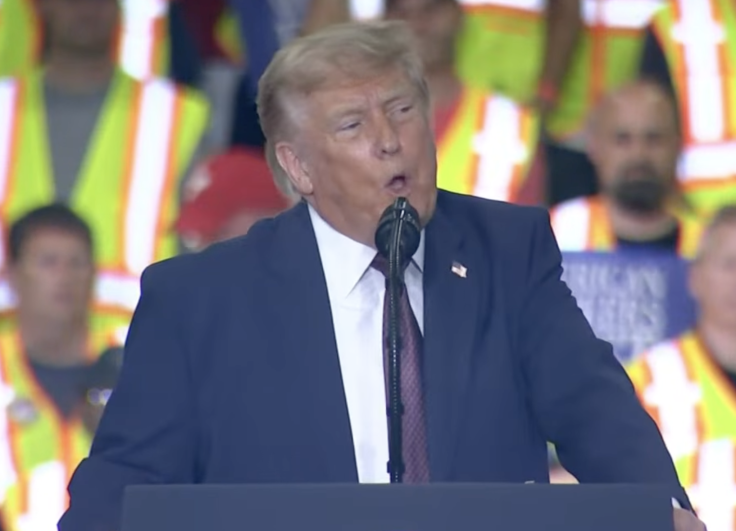
Speaking at the Mack Trucks Lehigh Valley Operations facility in Macungie, Trump told supporters that Iran had essentially been disarmed. In a sweeping boast about his supposedly new Iran deal, he said the country was left with 'no Navy, no Air Force, no antiaircraft, no missile capability, no nuclear program' and 'no nuclear capacity,' adding that 'they've agreed to that' and that the two sides were now 'getting along quite well.'
He went further still, claiming US aircraft could now operate over Iran's capital without fear. 'We can fly over Tehran just at will. Nobody's gonna do anything to us,' he said, in remarks captured on video and shared widely on social media.
A short clip of that section of the speech, posted on X by political video account @Acyn, clocked up attention precisely because of how dense it was with falsehoods. In roughly 15 seconds Trump managed to cram in at least six claims that do not match either his own previous statements or the public record on Iran's military posture.
Trump: We're leaving Iran with no navy, no air force, no anti-aircraft . no missile capability, no nuclear program, no nuclear capacity, and they've agreed to that, and we're getting along quite well pic.twitter.com/Fw0pEx3sKD
— Acyn (@Acyn) June 23, 2026
Iran's navy, for one, still exists. While US forces have destroyed multiple Iranian naval vessels over the course of recent confrontations, naval units belonging to the Islamic Revolutionary Guard Corps remain active and continue to operate in and around the Strait of Hormuz. If they did not, Iran would struggle to exert the control over that waterway that it still plainly does.
The same applies to its air force. Iran's fleet is old and in poor condition, but it does still have operational aircraft. Its nuclear energy programme also remains in place, along with the technical capacity to advance it further, even if that capacity is heavily monitored and contested. None of that squares with Trump's confident line in Pennsylvania that Iran has 'no nuclear program' and 'no nuclear capacity.'
The sharpest contradiction, though, was on missiles. Only last month, The New York Times reported that Iran retained 'substantial missile capabilities,' including ballistic missiles, despite damage inflicted by US strikes. That is not some fringe view, it is a widely accepted assessment echoed in multiple official and expert analyses and not seriously contested by the US government.
And Trump himself, as recently as last week, conceded that reality.
Trump's Own Words Undercut His Iran Missile Claims
At the G7 summit on Wednesday, Trump spoke about the need to run 'a parallel effort with the Gulf nations to address nonnuclear issues, such as [Iran's] conventional ballistic missiles.' He explicitly acknowledged that Tehran does, and in his view should, possess some missile capability.
'I mean, they have to have some. Because other people have some. You gotta have some,' he said. Describing advice he said he had received, Trump recounted: 'Somebody said 'You shouldn't give them more ... sir, you shouldn't let them have any missile.' ... What am I gonna do? I'm gonna let Saudi Arabia have missiles, but they can't have them?'
Those G7 comments directly undercut his Macungie speech line that Iran now has 'no missile capability.' In the space of a week, he shifted from arguing that Iran must have some missiles, because its regional rivals do, to claiming on stage in Pennsylvania that its arsenal has been wiped out and that Tehran has agreed to a deal leaving it with none at all.
The White House did not issue an immediate, detailed statement correcting Trump's Tuesday remarks, and there was no new treaty text or verified agreement published that would support his claim of an Iran deal erasing the country's military capacity.
What the administration has said, repeatedly, is that Operation Epic Fury inflicted heavy damage on Iran's forces. Trump and Defence Secretary Hegseth have presented that campaign as a turning point. According to their telling, the operation 'decimated' Iran's entire military and removed it as a threat.
Yet events since then have shown Iran continuing to use, retain or develop exactly the assets Trump insists he has taken away: naval forces, aircraft, a functioning nuclear programme and, crucially, missiles.
You do not need to be a weapons inspector to notice that gap between rhetoric and reality. It is sitting in plain sight every time Tehran test-fires a rocket or dispatches a patrol boat.
Trump's difficulty, as so often, is that he cannot seem to keep his own narrative straight. On Iran, he has bounced between arguing that the country is still strong enough to require bargaining and insisting that it has already been stripped bare. On Tuesday he picked the latter story, and it happened to be the one least connected to the facts.
For allies who want a clear reading of US policy, and for voters in places like Pennsylvania who will be asked to trust him with another four years in the White House, that kind of whiplash is not just confusing, it is exhausting. The world is messy enough without the commander-in-chief improvising the state of another country's missile arsenal on the fly.