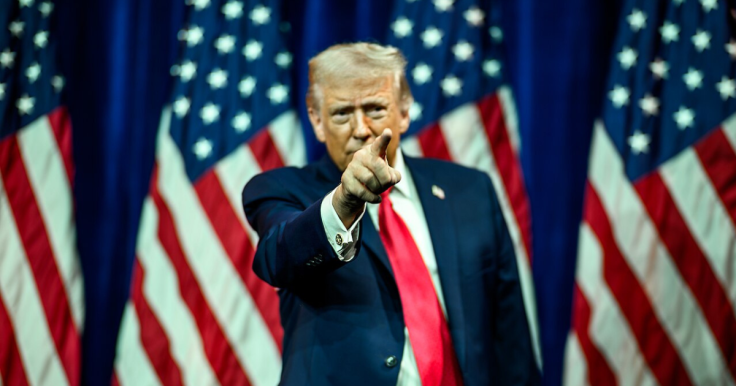
Donald Trump privately raged at aides over media coverage of his swollen ankles and even urged his press secretary to address the 'cankles' issue from the White House podium, according to a new book detailing the 80-year-old president's health troubles during his second term in Washington.
Regime Change: Inside the Imperial Presidency of Donald Trump by New York Times reporters Maggie Haberman and Jonathan Swan sets out a catalogue of age-related concerns that those around Trump allegedly witnessed up close. The book follows months of public scrutiny of the president's physical and cognitive condition, from his habit of nodding off in meetings to visible bruising on his hands and a rash on his neck, and attempts to piece together what was happening behind closed doors.

Donald Trump And The 'Cankles' Briefing
The latest allegation centres on Trump's response to press reports about his noticeably swollen ankles, which his doctors have attributed to chronic venous insufficiency, a condition where veins struggle to pump blood back to the heart. Haberman and Swan write that the president was angered by coverage of his 'cankles' and wanted his press secretary, Karoline Leavitt, to tackle the subject directly during a regular press briefing.
Some aides, the authors report, regarded the idea as strange and inappropriate for an official White House statement. Yet others saw it as entirely consistent with Trump's long-standing fixation with his public image and appearance. Nothing in the reporting suggests that such a briefing ever actually took place, and there is no formal transcript showing the issue being raised from the podium.
The book returns to a theme that will be familiar to anyone who has followed Trump's career. Even in the heart of government, aesthetics apparently remained non‑negotiable. Haberman and Swan describe how Trump's aide and personal valet, Walt Nauta, routinely followed him with a small arsenal of grooming tools: make-up, hairspray, Tic Tacs, a clothes steamer and scissors so the president could snip the back of his hair if it began to creep over his collar. The bruising on his hands, they add, was sometimes covered with make-up for public events.
Behind the scenes, though, the authors argue that the president's body was increasingly telling its own story. 'Despite personally dominating any room,' they write, 'his body could no longer fully conceal his age.' Those close to him, they say, started to see 'moments of fatigue' and the now-familiar gesture of a cupped hand behind his ear as he strained to catch questions.
Hearing Struggles, Naps And Rambling Speeches
The allegations in Regime Change do not stop at swollen ankles. Haberman and Swan say Trump was 'having trouble hearing, asking people to repeat questions they had just asked.' As a result, joint press conferences with visiting leaders were more often held in the Oval Office rather than the more formal East Room, partly because the acoustics were better and he did not have to stand for extended periods.
This sits alongside a pattern of public moments that have already fuelled speculation about his health. Since returning to office, the president has been spotted dozing off during White House meetings and even at high‑stakes international summits. Cameras have captured him rambling off topic during speeches and interviews, veering away from scripted remarks to pursue side arguments and grievances.
He has also repeatedly boasted of 'acing' a dementia screening exam, which he has presented as proof of his intelligence rather than a basic diagnostic tool. Visually, his occasional neck rash, swelling in his ankles and the bruising on his hands have all been picked over in press coverage and online commentary, often without much medical clarity.
Haberman and Swan stop short of diagnosing anything beyond what is already on the record, but they paint a picture of aides who, for the first time, began whispering that Trump genuinely seemed old to them. One line in the book notes that 'whatever thin verbal filter he had in the past was gone,' a judgment that will sound familiar to supporters and critics alike.
None of the more serious implications of these observations has been independently confirmed. The White House has not released detailed medical records addressing all of the issues raised, and the book's account rests on the authors' sourcing rather than public documentation, so some of the more intimate descriptions should be treated with caution.
White House Hits Back At Questions Over Trump's Health
Officially, the administration is having none of it. Asked about the claims, White House spokesperson Davis Ingle told that Trump's critics were looking in the wrong direction. 'President Trump's sharpness, unmatched energy, and historic accessibility stand in stark contrast to what we saw during the last administration when Democrats and the legacy media intentionally covered up Joe Biden's serious mental and physical decline from the American people,' Ingle said.
In a follow‑up line, Ingle added that Trump 'is the sharpest and most accessible President in American history who is working nonstop to solve problems and deliver on his promises.' The statement did not address the specific anecdotes in Regime Change about cankles, hearing issues or naps in meetings.
The political irony here is not subtle. For years, Trump branded his predecessor 'Sleepy Joe' and suggested that Biden was too frail to be commander‑in‑chief. Haberman and Swan's reporting now invites voters to look again at the age and health of the man making that charge, and at the carefully stage‑managed presidency around him, where even a swelling ankle can become a matter of state-level concern.
Nothing in the book has been corroborated by publicly released medical evidence, and some details rely on unnamed sources, so readers are left to weigh the authors' track record against the White House's flat denial and decide how much of the story they are prepared to believe.