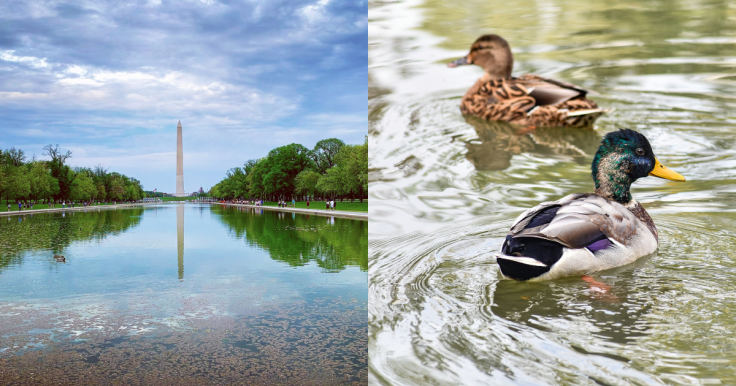
Wildlife investigators are conducting urgent necropsies on three ducks found dead near the Lincoln Memorial Reflecting Pool, intensifying public scrutiny over a controversial $14 million White House infrastructure project that has struggled with rampant algae blooms and construction failures. The discovery, which included a duckling floating in the algae-clouded reflecting pool and two other birds recovered from nearby Constitution Gardens, has transformed an already chaotic renovation effort into a significant environmental concern ahead of national independence celebrations.
Local wildlife experts, who monitor waterfowl populations on the National Mall, are now working to determine whether the birds were impacted by the chemical treatments or deteriorating materials from the recent overhaul. This incident follows weeks of public frustration as the iconic Washington landmark, recently recoated in a shade of 'American Flag Blue', has been beset by persistent water quality issues and structural degradation.
City Wildlife, a Washington rehabilitation group that monitors ducks on the National Mall, first told TMZ that, 'City Wildlife routinely conducts necropsies on ducks found deceased on the National Mall when the cause of death is unknown.' The organisation said it could not speculate on the cause before those tests were complete.
The pool was drained, recoated and refilled this month as part of President Donald Trump's push to remake the monument ahead of July Fourth celebrations marking the 250th anniversary of the Declaration of Independence. Within days of the refill, the pool had turned a vivid green with algae, and soon after, sections of the new blue liner began peeling from the bottom.
A Monument Makeover Turns Into a Wildlife Question
The renovation was supposed to deliver a pristine, camera-ready centrepiece for a White House celebration.
The overhaul, which Trump championed as a cheaper alternative to a more extensive federal repair, involved coating the basin with a rubber-like commercial liner painted in what he called 'American Flag Blue'. However, the pool's familiar problems returned almost immediately. Algae spread quickly across the roughly four million gallons of water, despite fresh treatment efforts and repeated assurances from officials that the makeover would improve the site.
The Interior Department has defended its response, saying that the hydrogen peroxide used to treat the bloom is milder than chlorine and is commonly used in spas and speciality pools. Officials have also used ozone nanobubble technology and manual vacuuming to clear the water. Earlier this month, the department said there were 'no harmful side effects to marine life or to the environment' from the treatment programme.
City Wildlife has stressed that duck deaths on the Mall are not unusual and can be caused by predation, injuries, drowning or natural causes. In urban environments, ducklings are especially vulnerable. But the organisation has also made clear that it is monitoring the reflecting pool closely while the repairs continue.
Pressure Builds For A Federal Investigation
The discovery of the birds has drawn in campaigners who argue the administration's handling of the pool deserves federal scrutiny.
The Centre for Biological Diversity asked the US Fish and Wildlife Service this week to investigate under the Migratory Bird Treaty Act, accusing officials of turning the pool into what one campaigner described as a 'giant duck death trap'.
The group has sharply criticised the use of concentrated peroxide in a pool frequented by wild birds, especially as algae and construction failures mounted around them.
Brad Bortner, the former national division chief of migratory bird management at Fish and Wildlife, said hydrogen peroxide at algae-control levels remains an unlikely explanation for the deaths. In his view, it would take a far stronger concentration to kill a duck outright.
'I know a few more dead ducks have been found, but hydrogen peroxide remains an extremely unlikely cause,' he said. 'They [would] have to pour hundreds or thousands of gallons of industrial-strength hydrogen peroxide into the reflecting pool to reach a concentration that would kill a bird.'
He also said a violation of federal bird protections would generally require a reasonably foreseeable risk, something he does not believe has yet been shown here.
Still, he acknowledged there are other possibilities. Ducks could potentially be affected by ingesting algae or fragments of the deteriorating liner, though he said that could not be known without testing.
The White House Wants A July Fourth Showcase
Trump has continued to insist the pool is 'beautiful', even while acknowledging that water may need to be drained again for repairs. He has blamed at least some of the vandalism damage, claiming criminal interference is responsible for sections of the liner lifting from the basin.
Francois Rivard, vice-president of Rhino Linings, said this week it was still unclear whether the peeling had been caused by manual interference or by something in the water itself.
Mike Selckmann of the Interstate Commission on the Potomac River Basin said that combination makes it a near-perfect incubator for blooms, including potentially harmful cyanobacteria. But he also stressed that only water testing could confirm whether toxic algae is present.
As the 4 July celebrations approach, the administration faces the dual challenge of managing a failing high-profile Washington, D.C., news story and addressing the growing public outcry over the safety of the wildlife that calls the National Mall home.