On September 21, 1944, a Japanese cargo ship called the Hōfuku Maru was sailing off the coast of the Philippines as part of a military convoy when American warplanes spotted it from above. What the pilots did not know could not have known was that the ship's dark, stifling holds were packed with over 1,200 British and Dutch prisoners of war, many of them survivors of the brutal Burma-Thailand Death Railway. A single torpedo cut the vessel in half. It went under in less than three minutes, taking more than 1,000 men with it. For over eight decades, the wreck sat undisturbed on the seafloor, its exact location lost to conflicting records, forgotten archives, and the fog of war. In 2026, a digitised Japanese document changed all of that.
Get breaking news anytime, anywhere. Download the TOI app now!
The hellships of World War II that history left behind
The Hōfuku Maru was not a one-off tragedy. Imperial Japan used more than 130 requisitioned cargo ships and passenger liners to transport prisoners between forced labour camps across South and Southeast Asia during the war. Allied POWs called them hellships, and the name was accurate. The holds were sealed, unventilated, and catastrophically overcrowded. Food and water were rationed to near-starvation levels. There were no sanitary conditions. Temperatures inside the metal hulls, sitting under the Pacific sun, became unbearable. Of the more than 125,000 Allied prisoners transported in these ships, an estimated 20,000 died. Crucially, Japan refused to mark these vessels as prisoner transports or notify the Allies of what they were carrying a practice no other combatant nation followed. As a result, Allied planes and submarines, operating on the assumption they were targeting military cargo, sank 19 of these ships. According to historian Gregory Michno, friendly fire accounted for 93% of all POW deaths on these vessels. The men were killed by their own side, through no fault of anyone but Japan.
A US naval officer, buried archives, and the search that took years
The Hellships Memorial Foundation, a US-registered non-profit, was set up by retired naval officer Randy Anderson specifically to pursue this forgotten chapter of the war. He was later joined by WWII historian Tim Beckensall and researcher John Duresky. The team spent years combing through long-overlooked records held in both American and Japanese military archives, and what they found kept pointing to the same uncomfortable conclusion: the Hōfuku Maru had not sunk where anyone thought it had. US records, it turned out, had been placing search efforts more than 30 miles off target for decades. Then, in June 2025, a breakthrough arrived. Duresky uncovered a digitised Japanese after-action report written by officers aboard the convoy's lead ship. The document included a hand-drawn map showing the position of every vessel in Convoy MATA-27, along with a time stamp: the Hōfuku Maru had sunk at 10:35 am. Hidden alongside it was an aerial photograph taken by the lead American Curtiss SB2C Helldiver moments before the attack. "We were absolutely stunned that Japanese sources had information on where the convoy was attacked and what ships were hit," Foundation founder Randy Anderson said. "This was a smoking gun."
Deep-sea photogrammetry and the wreck that finally matched
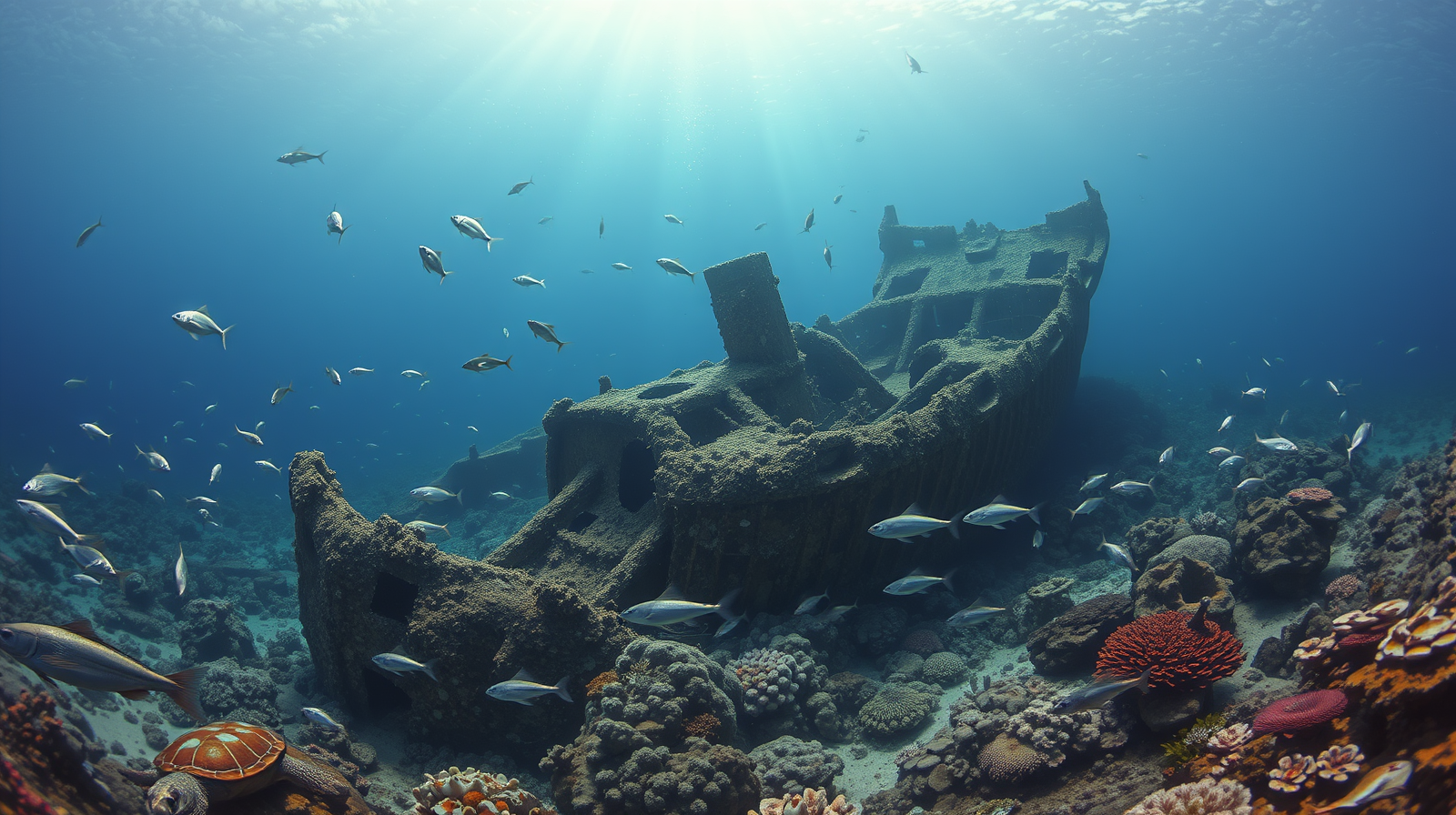
With revised coordinates in hand, the Foundation partnered with explorer Josh Gates, host of Discovery Channel's Expedition Unknown, along with underwater imaging specialist Evan Kovacs and maritime archaeologist Dr Calvin Mires of Marine Imaging Technologies. The team used sonar to locate an unknown wreck sitting more than 160 feet below the surface off Zambales province on the island of Luzon in the Philippines. What followed were deep technical dives and an extensive photogrammetry survey a technique that uses hundreds of overlapping photographs processed through specialist software to produce a precise three-dimensional model of an underwater structure. The size of the ship matched. The layout of its cargo holds matched. The positions of its masts matched. And critically, the wreck was split into two distinct sections, consistent with both American and Japanese wartime accounts of a torpedo strike that broke the ship in half. "The vessel is the right size, in the right place and from the correct period," Beckensall confirmed. "The pieces all fit."
Who was on board: POWs from the Burma-Thailand Death Railway
The men who died on the Hōfuku Maru were not simply prisoners of war in an abstract sense. Many had been forced to work on the infamous Burma-Thailand railway a construction project built through disease-ridden jungle under conditions of systematic brutality, a project history remembers as the Death Railway. After surviving that, they were loaded into the ship's holds for transport toward Japan. Some managed to swim ashore after the sinking. They were recaptured. The Hōfuku Maru represents the largest single-day loss of Allied POW lives from any hellship sinking. Over a thousand men most of them British and Dutch died within minutes. For decades, their final resting place was not known even to the people looking for it.
The Ōryoku Maru mission and what's happening underwater right now
The Hōfuku Maru is not the only hellship wreck drawing serious attention in 2026. In February, the US Defence POW/MIA Accounting Agency launched what it describes as the largest and most complex underwater recovery mission in the history of its programme, targeting the Ōryoku Maru in Subic Bay. That ship sank in December 1944, carrying over 1,600 Allied prisoners after being mistakenly bombed by US Navy aircraft from the USS Hornet and USS Cabot. The DPAA estimates that more than 250 Americans still lie inside the wreck. A 15-person dive team, deployed from the salvage vessel USNS Salvor, has been working through compartments in the demolished hull the wreck was blasted apart after the war to clear shipping lanes, leaving a mangled mass of steel at around 90 feet depth with poor visibility from the nearby river outflow. DPAA Director Kelly McKeague has said the recovery could take multiple years.
What both operations together represent is overdue. The hellship tragedy, 20,000 dead, most of them from Allied fire on unmarked Japanese prisoner transports, remains one of the least-discussed atrocities of the Second World War. There are monuments. There are names on walls. But for most of the men who went down on these ships, their exact location at the bottom of the Pacific remained unknown, their story largely absent from mainstream memory. The discovery of the Hōfuku Maru, and the active recovery mission at the Ōryoku Maru, are a reminder that eighty years is not always enough time to close a chapter. Some graves take that long just to be found.