It was the spring of 1985, back when Golden State’s NBA team, Warriors in name only, was a meek collective that lost more games than it won and seldom made the playoffs. But on a Sunday night in March, the Dubs scored a rare win—one of only 22 that season—against the Los Angeles Clippers in this, their first season at the L.A. Sports Arena. After spending the night at the LAX Marriott, Golden State headed, groggily, to board an early morning Western Airlines flight for its next game, against the Utah Jazz in Salt Lake City.
Ted Robinson, then the team’s radio and TV man, was part of the traveling party that, incredibly, only numbered 16—a dozen players, the head coach, one assistant coach, the trainer and the play-by-play guy. Once at the gate, Robinson trudged down the ramp and, upon boarding, made a right turn and headed to his customary seat in the second row of the economy section.
It had been league policy for years: NBA teams played road games, repaired to the hotel for a few hours of fitful sleep and then took the first flight out the next morning. Per the collective bargaining agreement, for flights longer than one hour teams were obligated to seat players in business class, if available. The premium cabin seats were given to the players not in order of status or contract size or height—woe to the seven-footer folded into coach. No, per NBA union rules, seats were meted out in order of seniority.
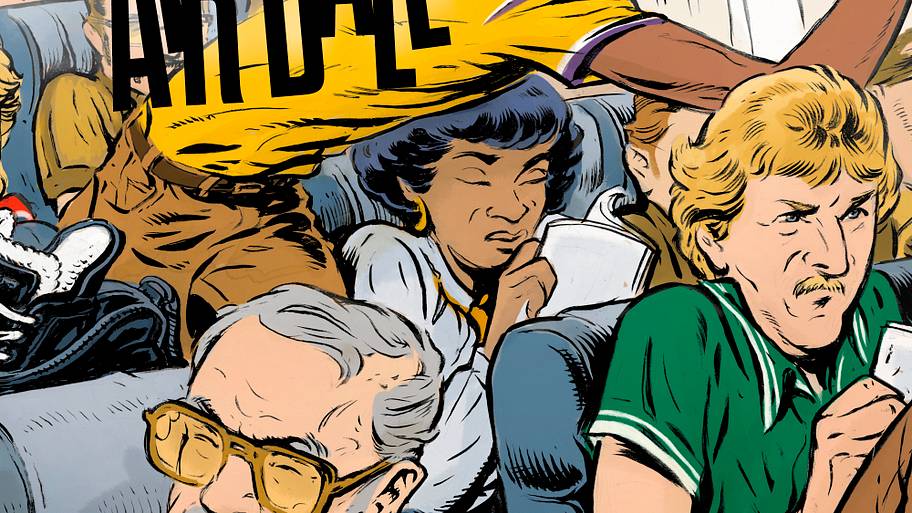
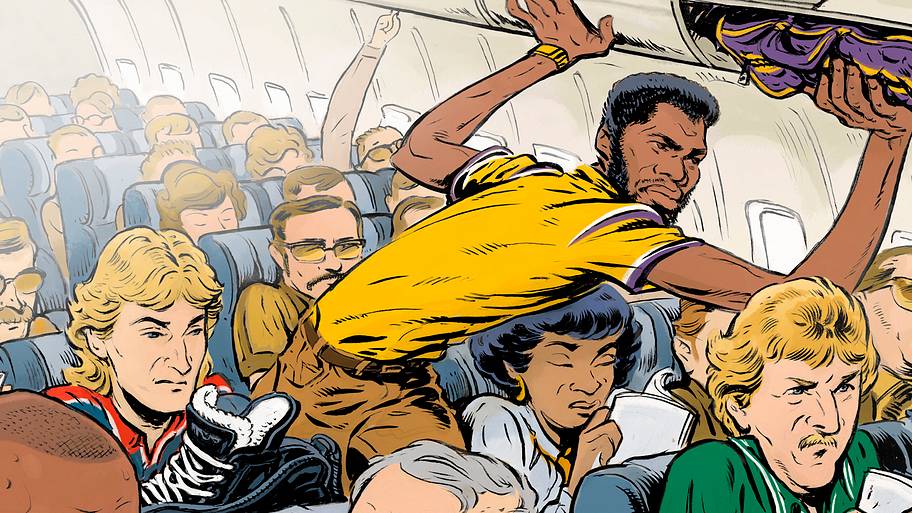
So it was, also that season, that the great Michael Jordan—already an ascending star with his own line of Nike shoes and a nickname, ironically, of Air—was a regular at O’Hare, going through security lines and whiling away delays, same as the insurance salesman from Skokie. Not only that, he sometimes flew coach. Would you like peanuts or pretzels?. Charles Barkley, drafted in the same 1984 class as Jordan, recalls being O.K. when Moses Malone and Dr. J. flew in the front of the plane. But it enraged him “when some [veteran] who didn’t even take his sweats off during the game” sat up front, while he wrestled a stranger for an armrest, as if contesting a rebound, in Row 29.
Anyway, by coincidence, the Warriors weren’t the only pro team on that particular flight from LAX to Salt Lake. The Edmonton Oilers had played against the Los Angeles Kings the previous night at The Forum. Their road trip over, they were flying home, and as was usually the case, there was no direct flight to Alberta’s second-largest city. With the Warriors players commandeering the first-class cabin, the entire Oilers team was consigned to steerage.
As Robinson took his seat, he heard a familiar voice from behind him, calling out, “Hey, Ted.” It was Edmonton defenseman Don Jackson, who’d been Robinson’s classmate at Notre Dame in the 1970s. As boarding continued, Robinson and Jackson chatted a bit and caught up. Jackson lamented that once in Salt Lake, the Oilers had to fly to Calgary and then to Edmonton.
And then Jackson said, “Hey, have you met Wayne?” Robinson was confused, but turned back to Row 32, to find a teammate of Jackson’s, blond locks poking out from under a baseball cap, who was not only marooned in a middle seat but also would be there for three legs of the flight, a “two-stopper” in the vernacular.
“Ted,” Jackson said. “Wayne Gretzky.”
A few weeks later, the player hemmed into that coach seat—while a 22–60 NBA team consumed the first-class inventory—would win his sixth NHL MVP award.
We now take it as an article of faith. Athletes in the major pro sports leagues don’t fly commercial. They also don’t wear football helmets made of tanned leather, call their own plays during competition or take second jobs in the offseason to supplement their incomes. If you see a pro athlete at an airport, odds are something has gone profoundly wrong. They’ve been traded. Sent home from a road trip. Cut, unceremoniously, from a roster.
Many college teams fly on charters. And not just in the revenue sports of basketball and football. (The Wake Forest tennis team flew for a stretch on a private jet. The reason: The PJ belonged to Sean Hannity, whose son was on the team.) Same for individual sport athletes, the top ones anyway, who thread the PGA Tour or get to their next tennis tournament on a plane identified by a tail number, not a flight number.
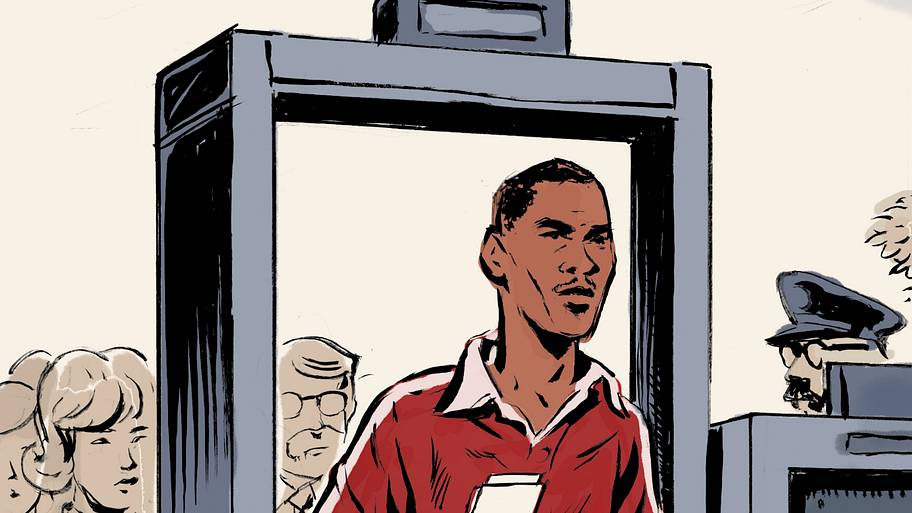
But this is a relatively new phenomenon. For the first half of the 20th century, teams took buses and trains and only occasionally planes. Some of this owed to the cost, these being the days before the sports industrial sector took off. Some of it owed to pragmatism. (Until the mid-1950s, the St. Louis Cardinals were the only baseball team west of the Mississippi, and that was only by a matter of a few miles.) Some of it owed to safety. Knute Rockne died in an aviation accident in 1931, and superstition only increased later when Roberto Clemente (1972) and Thurman Munson (1979) perished in plane crashes.
Through much of the second half of the 20th century, teams flew, but did so commercially, with boarding passes in hand, enduring delays and gate changes and holdups afterward at baggage claim. The 20th century was 90% over before athletes stopped going to airports and started going to airfields.
There were a few exceptions. Before decamping for L.A., the Minneapolis Lakers also flew private. Sort of. Writing in Defector, Dave McKenna recently told the story of the remarkable frugality of Lakers owner Bob Short. To save on travel costs, Short purchased a DC-3 prop plane, reportedly a converted World War II–era cargo hauler. During the 1959–60 season, after the Lakers lost a road game to the St. Louis Hawks, the team flew home, only for the plane to suffer an electric system failure. Peering out of the cockpit, the pilot made the decision to execute an emergency landing in an Iowa cornfield. (McKenna notes: “Less than a year after Buddy Holly crashed into an Iowa cornfield during a blizzard trying to get to Minnesota, the Lakers crashed into an Iowa cornfield during a blizzard trying to get to Minnesota.”)
The Lakers, happily, survived. At the owner’s behest, the plane was repaired at the site of the emergency landing, then flown home. When contacted for comment, Short, undeterred by the near catastrophe, noted they would continue flying to road games, “probably using the same craft.”
Less dramatically, the Brooklyn Dodgers were ahead of the charter trend. In 1950 the team acquired a DC-3 (lore has it the plane was given to owner Walter O’Malley by a pilot who’d won it in a craps game) and put the old warhorse to use shuttling players around Florida during spring training. After experimenting further with a pair of minor league clubs, in 1957 the team upgraded to a Convair 440 Metropolitan airliner, at a cost of $775,000, roughly $9 million in today’s dollars. Relocating to Los Angeles the following season, the Dodgers would go through three more planes before returning to flying commercial in 1983, like most other big league teams.
For decades MLB had a curious policy: Teams carried far too many players to ensure first-class airfare for the roster. But—again, thanks to collective bargaining with the players’ union—teams bought three seats for every two players, so each player was spared from having to sit in a middle seat. (At times, this infuriated other air travelers, denied, as they were, standby seats on planes, though dozens of empty seats went intentionally unoccupied.)
The NBA had a similar policy. If players were bumped to coach, the team had to purchase the adjacent seat or pay the player the difference between the coach fare he used and the business fare he was denied. (On the 1984–85 Warriors, head coach John Bach sat in first class, deeming it a blow to his authority had he sat behind players. The 12th man, presumably, was happy to supplement his $65,000 league-minimum salary with the airfare payments.)
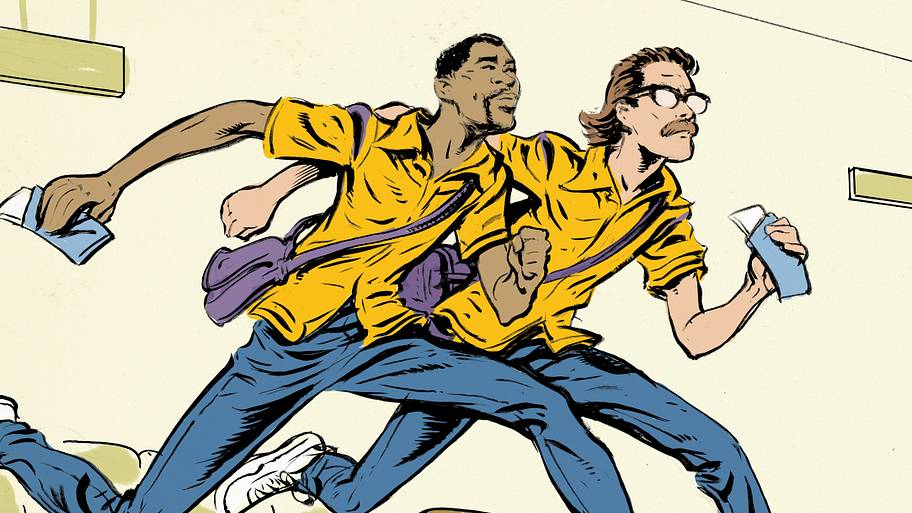
To say that NBA owners were chintzy when it came to matters of team travel would be trafficking in understatement. When the Philadelphia 76ers were in the 1983 NBA Finals, owner Harold Katz considered arranging a charter to Los Angeles if media members chipped in and paid $600 each to take the flight as well. One problem: a “supersaver” promotion priced the commercial fare at $318. When there were insufficient takers among the newspapermen, Sixers coach Billy Cunningham sweetened the deal, calling reporters at home and promising that the charter flight would wait until the writers had filed their stories before taking off. Still not enough takers. So when the “Fo-Fo-Fo” Sixers swept the Lakers, they flew commercial to and from Los Angeles, stopping in Chicago.
Likewise, during the NBA Finals the following season, the Lakers won Game 6 at The Forum, forcing a decider against the Celtics back in Boston. This was a seminal moment in NBA history. Another chapter in a textured rivalry. The first iteration of Magic vs. Bird. East Coast vs. West Coast. Boffo television ratings. And yet the Lakers not only flew commercial to this, the biggest game of their season; they also flew to Washington, D.C., and then took a connection north to Logan.
When the Lakers ended up losing Game 7, 111–102, there were all manner of explanations. Boston Garden heat so extreme that a referee fainted. The superior toughness of Bird, Kevin McHale, Dennis Johnson, et al. Even the damn leprechauns in the parquet. In no account did anyone mention that sleeping with your head on a tray table and then finding your connecting gate for the last hour of transit does not tend to optimize sports performance.
The woes of commercial travel weren’t just about abnormally tall men pretzeling their bodies into small seats. To guard against flight delays and cancellations, teams took the first morning flight and, on too many occasions to count, spent the bulk of the day—game day, often—in airports, awaiting the resolution of maintenance issues and the arrival of new flight crews.
Even when the teams landed, their travel was often incomplete. Richfield Coliseum, the longtime home of the Cavaliers, was more than 20 miles from the Cleveland airport. The Detroit airport is nearly 50 miles from the Palace at Auburn Hills. Perhaps, then, it’s no surprise that the Pistons in 1987 ponied up for a private plane, Roundball One, a BAC-11.
Marooned in the Pacific Northwest, the Portland Trail Blazers also got into the plane game early. When he purchased the franchise in 1988, Paul Allen was the NBA’s wealthiest owner. He spent generously on the team, (over)paying players, building a new arena on his own dime, and purchasing Blazer One, a 38-seat Boeing 757. It was not merely a private plane but sufficiently souped-up—flush with a wet bar, a master bedroom, flat screens before they were the only screens—that other teams argued it provided such an in-kind benefit it should count against the Blazers’ salary cap.
It was not a cap violation. And by the early ’90s, most franchises were chartering flights for at least some of their road trips. In 1991, the Salt Lake City newspaper The Deseret News covered the trend, as it pertained to the Jazz: “In addition to the $55 a day in meal money … nowadays there’s even more motivation to want to play in the NBA: charter flying.”
Apart from laying out the basics of charter travel, the account framed this change as a polarizing issue worthy of debate. Utah forward Blue Edwards said, “I’m not fond of going to bed late and getting up for a 6 a.m. wake-up call to go to the next city. I’d rather get into a city late, and sleep until 10 or 11 the next morning. So chartering works out better.” But not so fast. Edwards’s teammate Jeff Malone expressed a preference for commercial airfare, saying of charter travel: “I don’t like it. You end up going to bed sometimes four, five in the morning. Some guys can handle it better than that, but I don’t like it.”
The best quip on this controversial topic that season may have come from Dick Motta, coach of the Sacramento Kings. For two seasons, the Kings leased a private jet. It included VCRs, couches, catered meals and tables that folded down for dining or card playing. The Kings, however, won only one of 41 road games in the 1990–91 season. Motta was quick to note, “I don’t think we would have won that game if we didn’t have the plane.”
The same cost-conscious owners who once viewed private charter as an unnecessary indulgence were increasingly able to make a business case for private air travel. At first, as an inducement for luring free agents. Then, not as a luxury, but as a source of competitive advantage.
They may not have been armed with today’s sleep science data, correlating rest with performance, but it stood to reason that players arriving to a game on a flat bed would play better than those who’d walked zombified through airports a few hours before tip-off. (Consider that in 1987–88, two NBA teams had winning road records; this past season it was 14.)
Though seldom discussed, there was another competitive advantage to flying on charters. Those flights depart shortly after games end, unusually from the airfield nearest to the arena. Players sleep (or don’t) on the flight. It arrives in the city of the next game, sometimes as the sun comes up. Players check into their hotel and can return to sleep. As legendary NBA coach Larry Brown once said: “It’s a lot harder [for players] to get into trouble 30,000 feet in the air than it is going out on the town before your first flight out.”
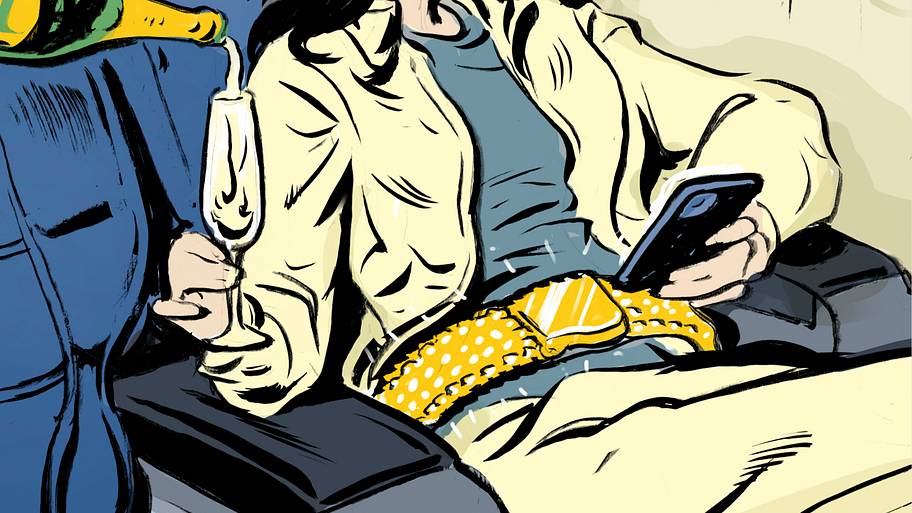
Talk of charter flights re-entered the sports airspace in 2022, when Sports Illustrated reported that the New York Liberty flew privately to games and to Napa for a fun diversion. The existing WNBA collective bargaining agreement required that teams transport players in “premium economy (or similar enhanced coach fare) if available.” Private airfare was deemed a contravention of the salary cap and the Liberty was fined $1 million, reduced to $500,000 on appeal.
In 2023, the issue of WNBA commercial air travel gained altitude for another reason. Phoenix Mercury center Brittney Griner was playing her first season after a diplomatic crisis, in which she spent nearly a year in Russian detention until she was freed in a controversial prisoner exchange. As she walked through the Dallas-Fort Worth airport with her team, she was accosted by an aggressive social media personality. Griner’s agent, Lindsay Kagawa Colas, hardly unreasonably, used the episode to advocate for an upgrade. “We cannot celebrate these women and their leadership without also protecting them,” Colas tweeted. “It’s past time for charters and enhanced security measures for all players.”
Though the CBA had not lapsed, in May 2024 the WNBA announced that teams would no longer fly to games commercially and, instead, would travel on Delta charter flights. Coincidence or not, this was concurrent with Caitlin Clark’s entry into the league. The image of Clark, a sports celebrity of the highest order, slogging through the Indianapolis airport before and after Fever games would, at a minimum, have made for lousy optics.
By that point, NBA travel had turned into a midair arms race. The Houston Rockets have a customized Boeing 767 that includes mood lighting. Each Airbus A321neo the league leases to teams seats up to 72 passengers and features couches and personal chefs and all manner of monitors and video screens. The First Gen charter flights from the late ’80s and early ’90s are now as quaintly old-timey and obsolete as athletes traveling via Pullman. Or, for that matter, flying commercially.
Years ago, Roundball One, the Pistons’ former jet, was donated to an aviation school. As for the Blazers’ first team plane, per longtime Portland journalist Kerry Eggers, Paul Allen sold the aircraft in 2011 for $100 million to … Donald Trump.
The seat belts, Eggers reported, were soon 24-carat gold-plated.